Agriculture FarmTech AI: Data-Driven Intelligence, Leading the Sustainable Agriculture Revolution
For millennia, agriculture has been the cornerstone of human civilization, rooted in the land and relying on farmers' sweat, experience, and reverence for nature. However, under the immense pressure of intensifying global climate change, increasingly scarce water resources, degrading soil health, and a continuously growing global population, farming models that rely solely on traditional experience are facing unprecedented challenges. To ensure future food security and achieve environmental sustainability, a revolution in agricultural technology driven by Artificial Intelligence (AI)—"Agriculture FarmTech AI"—has emerged, promising to inject data-driven intelligence into every inch of land, empowering farmers to become more efficient, precise, and forward-looking cultivators of the future.
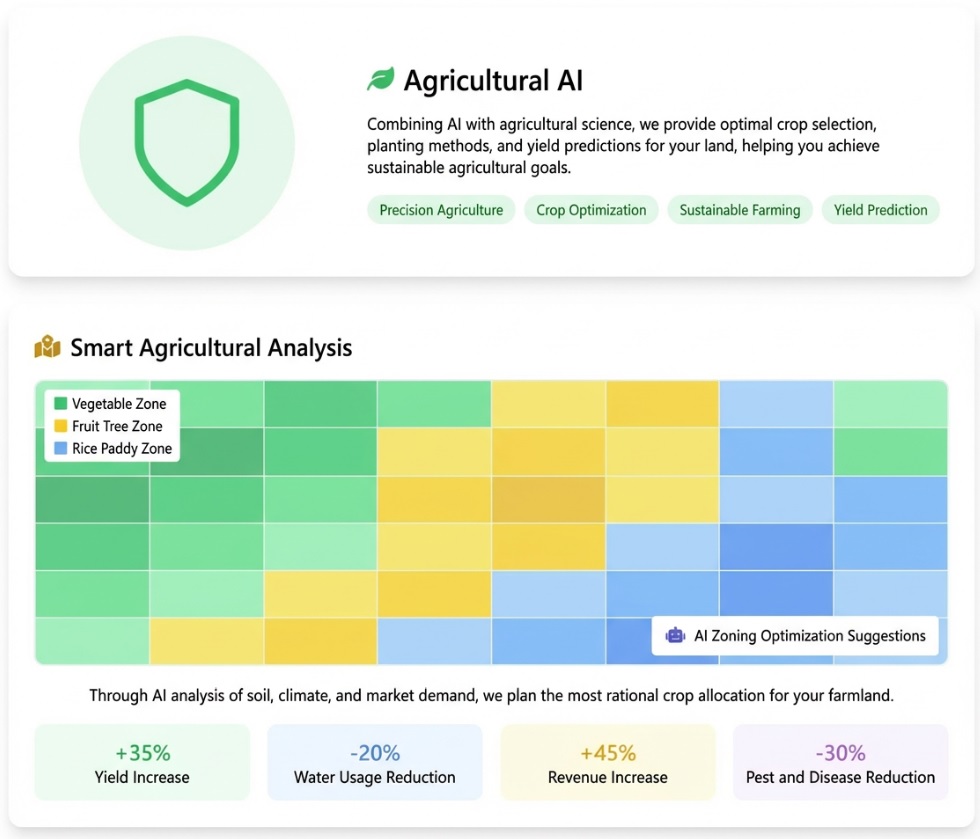
"Agriculture FarmTech AI" is an integrated smart agricultural solution, acting like an omniscient digital chief agronomist capable of providing scientific guidance across the entire chain, from crop selection and planting management to yield prediction. Its core goal is to transform agriculture from an art of "living at the mercy of the weather" into a data-driven, predictable, and optimizable precision science.
Core Technologies: How AI Deeply Interprets Land and Crops
The powerful capabilities of this platform stem from its ability to integrate and analyze multi-source heterogeneous data, combining frontier technologies from precision agriculture, crop science, machine learning, and climate modeling.
Comprehensive Land Diagnosis and Potential Assessment: The first step for the AI is to conduct a thorough "land physical examination." Users only need to provide basic information such as the farm's geographical location, area, and historical crops, and upload field photos or drone aerial images. The AI will then integrate and analyze:
Soil Data: Combining soil databases with user-provided soil test reports (or through visual analysis of soil color and texture), the AI can assess soil pH, organic matter content, NPK (nitrogen, phosphorus, potassium) ratios, and trace element status.
Climate and Environmental Data: Analyzing historical meteorological data over many years (temperature, rainfall, sunshine hours) and future climate trend predictions to determine the region's growing season length, frost risk, and potential drought or flood threats.
Topographic Data: Through satellite Digital Elevation Models (DEM), the AI can analyze the land's slope and aspect, which is crucial for planning irrigation systems and preventing soil erosion.
Intelligent Crop Recommendation and Rotation Planning: Based on a comprehensive assessment of land potential and combined with user-defined agricultural goals (e.g., pursuing maximum profit, achieving high water-use efficiency, improving soil health, or supplying specific markets), the AI's recommendation engine filters the most suitable planting schemes from a massive crop database.
Beyond a Single Choice: The AI's suggestions are not singular. For example, for a piece of land, it might point out: "Planting corn with high market prices can bring high short-term returns, but its water consumption is large and may exacerbate local water stress. In contrast, planting sorghum is not only more drought-tolerant, but its deep root system also helps improve soil structure. We recommend a three-year rotation plan of corn-soybean-sorghum to balance economic returns with land health."
Variety-Level Precision Matching: AI recommendations can be precise down to specific crop varieties. It will suggest commercial varieties that are most resistant to common local pests and diseases, best adapted to local daylight hours, and have the greatest yield potential.
Dynamic Management of Precision Agriculture: Once the planting plan is determined, the AI generates a detailed dynamic management scheme that spans the entire growth cycle, putting "precision agriculture" into practice.
Variable Rate Fertilization and Irrigation: The AI generates "Prescription Maps" to guide agricultural machinery in applying different doses of fertilizer and water to different areas of the field, achieving "supplementing what is lacking and in the exact amount needed," significantly reducing waste and environmental pollution.
Pest and Disease Early Warning: By continuously monitoring satellite imagery and meteorological data, the AI can build prediction models for pest and disease outbreaks. Once conditions are found to be ripe, it will issue an early warning to users and suggest precision interventions using biological controls or low-toxicity pesticides to avoid large-scale chemical use.
Yield Prediction and Economic Benefit Analysis: This is a key feature that seamlessly connects agricultural production with business operations. The AI uses crop growth models combined with real-time weather data and management execution to perform dynamic yield predictions.
From Yield to Profit: Prediction is not just about "how many tons can be harvested per hectare"; the AI also combines price trends in the agricultural futures market with input costs such as seeds, fertilizers, and labor to estimate final net profits for farmers, helping them make smarter sales decisions (such as choosing the right time to sell or signing forward contracts).
User Experience: Seamless Connection from Input to Intelligent Solutions
For farmers, the interaction process with "Agriculture FarmTech AI" is designed to be extremely simple and intuitive:
Information Input: Users log into the platform, circle their farm boundaries on a map, upload a few photos reflecting soil and existing crop conditions, and set their primary agricultural goals through checkboxes (such as "Profit Maximization," "Ecological Sustainability," "Water Conservation Priority," etc.).
AI Cloud Analysis: The AI engine in the platform's backend completes the crawling, integration, and deep learning analysis of all relevant data within minutes.
Generate Comprehensive Report: The AI finally outputs a comprehensive agricultural planning report with both text and graphics, which is easy to understand and includes:
Optimal Crop Configuration Map: Clearly marking the most suitable crop types for different plots within the farm.
Detailed Planting Calendar: Containing a complete schedule and operation guide from land preparation, sowing, fertilization, and irrigation to harvest.
Resource Budget List: Accurately estimating the required amounts and budgets for seeds, fertilizers, pesticides, and water.
Yield and Return Forecast: Providing yield and economic return predictions under high, medium, and low scenarios.
Risk Warnings and Response Strategies: Highlighting potential natural disasters or market risks and providing mitigation suggestions.
Far-reaching Impact: Empowering Farmers, Protecting the Planet
The birth of "Agriculture FarmTech AI" means much more than just improving the efficiency of a single farm.
For Farmers, it lowers the threshold for adopting new technologies and farming models, reduces operational risks, and transforms agricultural decision-making from "gambling" to "science," ultimately achieving stable income growth.
For the Food Supply Chain, more precise yield predictions help stabilize market expectations, reduce price fluctuations, and safeguard national and even global food security.
For the Planet, by promoting sustainable farming methods, it effectively reduces chemical abuse, protects precious water resources, and promotes healthy soil regeneration, serving as a powerful weapon against climate change and for protecting biodiversity.
Customized, AI-assisted FoodTech research costs start from HK$5000+, depending on requirements. Please contact us for details and pricing!
Conclusion
"Agriculture FarmTech AI" is not intended to replace farmers' hands and generations of inherited experience but to be their most powerful eyes, brain, and ally. It condenses global agricultural science knowledge, real-time environmental data, and powerful computing capabilities into a simple and easy-to-use interface, allowing every cultivator to stand on the shoulders of giants. This is a profound revolution in agricultural productivity and a necessary path to a more prosperous, greener, and more resilient future.
Agricultural FarmTech AI Frequently Asked Questions (FAQ)
What is Agricultural FarmTech AI?
Agricultural FarmTech AI (Agricultural Farm Technology Artificial Intelligence) is a smart agricultural solution that deeply integrates artificial intelligence with agricultural science. It transforms agriculture from the traditional "relying on the weather" model into data-driven precision management. The core goals are to enhance production efficiency, reduce resource waste, and achieve environmental sustainability.
What are the core functions of Agricultural FarmTech AI?
The core functions of Agricultural FarmTech AI lie in data-driven precision decision-making. Through sensors and image recognition, AI can monitor crop pests and diseases in real-time, analyze soil fertility and climate change, and automatically adjust irrigation and fertilization plans. This not only significantly reduces the waste of pesticide resources but also predicts harvest yields and addresses labor shortages through smart machinery, transforming traditional agriculture into a highly efficient and stable smart production model.
What are the applications of Agricultural FarmTech AI?
Agricultural FarmTech AI is widely used in precision monitoring and automated production. Using drone imagery to identify pests and diseases allows for precise local spraying; sensors automatically trigger irrigation based on soil moisture. Additionally, AI can predict market prices and weather risks, optimize harvesting schedules, and integrate automated robots to perform weeding and harvesting tasks, achieving smart sustainable agriculture with low resource input and high output.
What are the key advantages of Agricultural FarmTech AI?
The key advantages of Agricultural FarmTech AI are the maximization of productivity and precise cost control. It uses data analysis to minimize the use of pesticides and fertilizers, reducing environmental pollution and saving expenses. Meanwhile, AI early-warning systems can significantly reduce the risk of disasters brought by extreme weather. This not only solves the pain points of an aging agricultural workforce and labor shortages but also achieves a win-win goal of stable yield and environmental sustainability through scientific management.
Why is the technologization of agriculture important?
Agricultural technologization is key to addressing global food security and climate change. By introducing technology, the gap left by an aging agricultural workforce can be filled, and yields can be increased under limited resource conditions. Technologization shifts farming from being "experience-oriented" to "data-driven." It not only precisely reduces chemical fertilizer pollution to protect the environment but also strengthens disaster resilience through smart early warnings, making it an indispensable means of achieving sustainable agricultural development and increasing output value.
What is technological and smart agriculture?
Technological and smart agriculture is the deep integration of hardware equipment with software big data. The former utilizes mechanization and sensors to enhance production physical capacity, while the latter grants the farm a "brain" through AI and the Internet of Things (IoT) to achieve autonomous decision-making and precision management. This transformation effectively responds to labor shortage challenges, accurately allocates water and fertilizer resources, and elevates agriculture from labor-intensive to a high-performance digital industry, ensuring stable yields and environmental sustainability.
What are the future development trends of Agricultural FarmTech AI?
Future development trends for Agricultural FarmTech AI will focus on full automation and digital twin technology. Through 6G networks and edge computing, AI will achieve synchronized monitoring and prediction between the physical farm and its digital model. In the future, it will combine Generative AI to create agricultural expert systems and integrate with carbon credit tracking technology, transforming agriculture from simple production into a green smart ecological chain that possesses both carbon reduction value and high autonomy.
Why choose FoodTech AI's Agricultural FarmTech AI service?
FoodTech AI's FarmTech AI service combines over 20 years of operational experience from the Hong Kong food brand "Eat East" (波仔). Through "full-chain scientific guidance," it provides precise land health checks, crop matching, and dynamic management solutions. The FarmTech AI service assists farmers in shifting decision-making from experience to data science, effectively reducing risks, increasing yields, and saving resources to achieve smart agriculture and ESG goals.