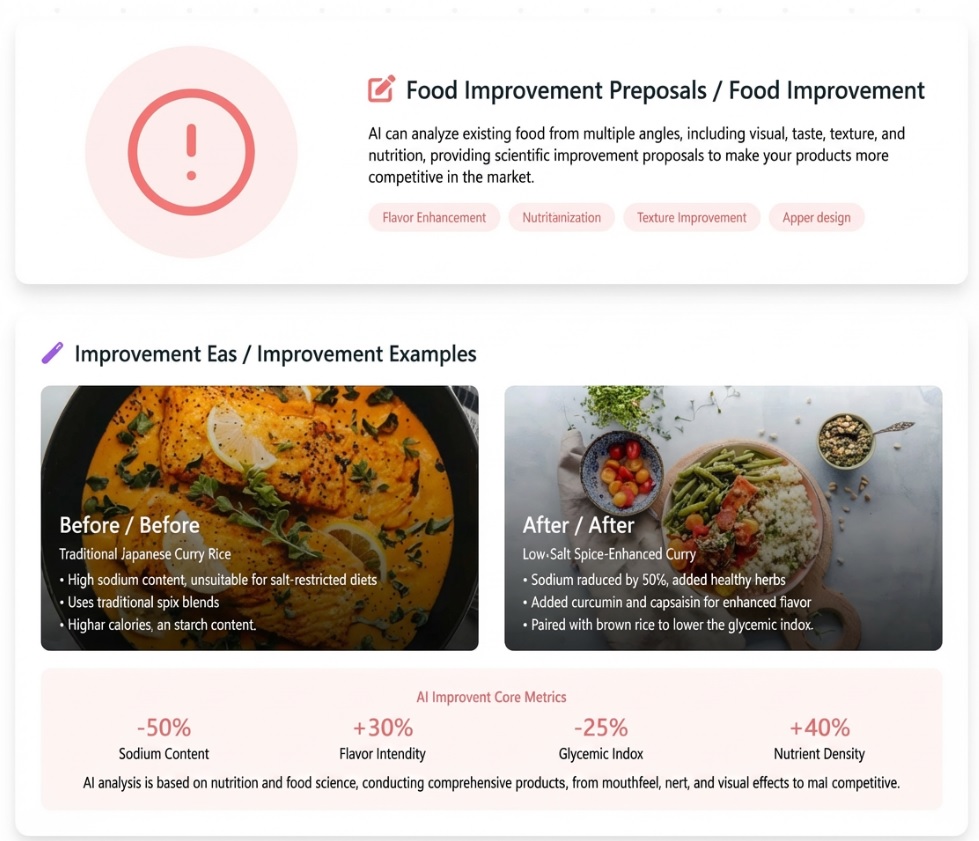
In today's dazzling and fiercely competitive food market, consumers' taste buds have become more discerning than ever. They not only seek deliciousness but also hold high expectations for health, experience, and sustainable value. The difference between a "tasty" product and a "best-selling" one often lies in a subtle yet crucial improvement. However, traditional product optimization processes are time-consuming, expensive, and heavily reliant on limited expert experience. Now, a revolutionary tool—"Food Improvement Suggestion AI"—has emerged, acting as your 24/7 virtual R&D consultant, utilizing the power of data science to inject unparalleled market competitiveness into your products.
The core mission of this AI tool is to transform complex food science and sensory analysis into intuitive, actionable, and scientific improvement plans. It aims to provide unprecedented support for all food creators, from the R&D departments of large food enterprises to small and medium-sized bakeries, restaurant chefs, and even passionate home cooks, ensuring that every iteration of a product is precise and efficient.
Multi-dimensional Deep Analysis: How AI "Tastes" and "Insights" Your Food
When a user uploads a food photo along with a simple description (e.g., "my cheesecake tastes too heavy") and an improvement goal (e.g., "hope for a lighter texture and more attractive appearance"), the AI activates its powerful multi-dimensional analysis engine. It doesn't just "see" an image; it performs a comprehensive digital deconstruction of your product at the data level.
Appearance Analysis: As the saying goes, "we eat with our eyes first." The appearance of food is the first threshold for attracting consumers. AI's computer vision algorithms, trained on a vast array of gourmet food images, can evaluate your product's aesthetic performance from a professional perspective. It analyzes:
Color: Is the color vibrant and tempting? Is the color combination harmonious? AI might suggest: "Increasing the red saturation of the strawberry jam by 5% can more effectively stimulate the appetite."
Shape and Structure: Is the product's contour regular? Are the layers distinct? For baked goods, it can judge if the expansion is ideal. Suggestions might be: "The air pockets in the bread are unevenly distributed; it is recommended to adjust the fermentation time or yeast dosage to obtain a more uniform internal structure."
Surface Texture: Is it an attractive caramelized gloss or a refreshing matte finish? AI can identify surface glossiness, crispness, or moisture and compare them with "gold standards" in its database.
Flavor Layer Optimization: Flavor is the soul of food. Based on the user's description and ingredient list, the AI calls upon its massive Flavor Pairing Database. This database contains not only traditional flavor pairing principles (like tomato with basil) but also synergistic effects of flavor compounds at the molecular level.
Balance: For a "heavy" cheesecake, AI won't just give a vague answer like "reduce sugar and fat." It might suggest: "Adding 0.5% lemon juice or yuzu zest; its aromatic acid compounds can effectively neutralize the heaviness of dairy products and enhance overall freshness."
Richness: If a user feels the product's taste is one-dimensional, AI might suggest introducing new flavor dimensions, such as: "In this dark chocolate cookie, adding a trace of sea salt and a pinch of chili powder can sequentially trigger sweet, salty, and spicy taste sensations, creating a deeper taste memory."
Texture Science Reshaping: Texture, or mouthfeel, is key to the food experience. AI links user descriptions (such as "too dry" or "not crispy enough") with the physical and chemical principles of food.
It understands the interactions between proteins, starches, fats, and moisture. For a "too dry" cake, AI might analyze its formula and suggest: "Replacing part of the all-purpose flour with almond flour, which has a higher fat content that helps retain moisture; or adding a small amount of invert sugar syrup as a humectant to the recipe."
For fried chicken seeking "crispiness," AI might suggest using a double-frying method and adding a certain proportion of cornstarch to the batter, as its high amylose content can form a more stable crispy structure.
Nutritional Value Calculation: Health is a core demand of modern consumption. AI can quickly estimate the nutrition label based on ingredients provided by the user and provide precise plans based on improvement goals (such as "high protein," "low carb," or "suitable for children").
Fortification and Substitution: Want to develop a Keto bread? AI will suggest using psyllium husk powder and flaxseed powder to simulate the structure of flour and using erythritol instead of sucrose.
Functional Additions: Aiming for a refreshing snack for office workers? AI might suggest adding matcha powder rich in theanine or berries with antioxidant functions.
Sustainability Suggestions: This is a forward-looking feature that gives products higher ethical standing and storytelling potential in the market. AI evaluates the environmental impact of every ingredient in the formula.
Raw Material Substitution: AI might point out: "The palm oil you use poses a risk of destroying rainforests. Consider using more sustainable alternatives such as rice bran oil or algal oil."
Upcycling: If the product is fruit juice, AI might suggest: "The remaining pomace is rich in fiber and can be dried and ground into powder to be added to energy bars or baked goods, which not only reduces waste but also creates new product value."
From Insight to Action: Empowering Every Creator
The ultimate goal of "Food Improvement Suggestion AI" is empowerment. It ensures that cutting-edge food science knowledge is no longer the exclusive domain of a few experts but becomes a readily available tool.
For startups and small businesses, it greatly lowers the R&D threshold and trial-and-error costs, enabling them to compete with big brands on product quality.
For large enterprises, it can accelerate product iteration cycles, freeing R&D teams from tedious basic testing to focus on more breakthrough macro-innovations.
For the general food enthusiast, it is a mentor and friend that inspires creativity and enhances culinary skills.
Customized, AI-assisted FoodTech research costs start from HK$5000+, depending on requirements. Please contact us for details and pricing!
Conclusion
"Food Improvement Suggestion AI" is not intended to replace human creativity and intuition but to be their most powerful amplifier. It is like a knowledgeable and tireless partner, injecting data precision and scientific rigor into the world of cooking, which is full of emotion and art. By providing deep insights into the five key dimensions of vision, flavor, texture, nutrition, and sustainability, it is redefining the possibilities of food innovation, helping every carefully crafted product find its brightest place in the market, and ultimately bringing a better, healthier, and more responsible food future to consumers.
Food Improvement Suggestion AI Frequently Asked Questions (FAQ)
What is Food Improvement Suggestion AI?
Food Improvement Suggestion AI is an intelligent tool created by FoodTech AI that combines food science with data analysis. It aims to analyze existing food products across dimensions such as appearance, taste, texture, and nutrition, providing scientific optimization suggestions to help companies enhance their market competitiveness.
What are the core functions of Food Improvement Suggestion AI?
The core functions of Food Improvement Suggestion AI revolve around three key areas: data-driven formula optimization, sensory quality enhancement, and the acceleration of research and development (R&D) efficiency.
How does Food Improvement Suggestion AI work?
Food Improvement Suggestion AI uses reverse engineering to deconstruct the sensory indicators and molecular structures of food, establishing digital benchmark models combined with big data. It then utilizes multi-objective optimization methods to accurately calculate the best formulas for reducing salt, lowering sugar, or replacing ingredients with natural additives while maintaining flavor. Finally, through visual recognition and simulation technology, it provides scientific improvement suggestions for texture, nutrition, and production costs, shifting traditional R&D from blind trial-and-error to data-driven precision development.
What are the benefits of Food Improvement Suggestion AI for enterprises?
Food Improvement Suggestion AI significantly shortens the R&D cycle for enterprises, reducing traditional months of trial-and-error to just a few days, and markedly lowering raw material waste and labor costs. Through data analysis, the AI can accurately target market trends, helping brands quickly launch products that meet demands for healthy low-sugar options or clean labels, thereby increasing market competitiveness. Additionally, it optimizes formulas to reduce ingredient costs and integrates ESG data to achieve energy savings and carbon reduction, helping companies find the optimal balance between quality and sustainable operations.
What are some examples of application scenarios for Food Improvement Suggestion AI?
Application scenarios for Food Improvement Suggestion AI have reached every stage from R&D and production to retail. Four representative examples include: 1. Healthy formula reformulation (Clean Label & Health), 2. Visual aesthetics and texture optimization, 3. Market benchmarking and innovative flavors, and 4. Personalized nutrition and smart management.
What are the future development directions for Food Improvement Suggestion AI?
Future Food Improvement Suggestion AI will move toward hyper-personalized nutrition and automated sensory simulation. By integrating data from wearable devices, it will achieve functional formulas tailored specifically to individuals. Technologically, it will integrate Generative AI and Digital Twins to complete molecular-level flavor testing in virtual laboratories, largely replacing physical tastings. Simultaneously, AI will deeply interface with sustainable supply chains, dynamically optimizing formulas to respond to raw material shortages caused by climate change, driving an era of smart eating characterized by precision, environmental friendliness, and ultimate taste.
Why choose FoodTech AI's Food Improvement Suggestion AI service?
FoodTech AI's food improvement service combines 20 years of practical experience from the "Eat East" (波仔) brand with scientific data, shortening the R&D cycle to 3–6 months and reducing development failure rates by 80%. The FoodTech AI platform provides a one-stop solution including flavor deconstruction, recipe generation, and cost control, assisting catering businesses in improving quality and achieving ESG goals.